Sunday Telegraph Cryptic No 3363
A full review by Rahmat Ali
+ – + – + – + – + – + – + – +
This puzzle was published on 5th April 2026
BD Rating – Difficulty ** – Enjoyment ****
Greetings from Kolkata. Dada has given us an excellent and friendly solve this Sunday and now I present to you a full review of his puzzle. Hope to have your valuable feedback and comments.
Icarus, the answer to the clue at 25a, made me nostalgic. I first read about Icarus and in a history book called ‘The March of Time’ when I was nine and studying in Class IV in Joseph Day School. Those were the days when the academic session used to run from January to December and we used to enjoy our winter vacation during December and January for around 25 days every year. Winter then used to be really, very cold for at least one month, in between two colder months starting from mid-November to mid-February. These days, an academic session is from April to March and the winter vacation for school children is for 10 to 12 days only. That real winter season is no longer there. It is now only mildly cold for around two months with a slightly colder spell lasting 6 to 7 days between December and January. We used to get a book list along with our 3rd Term Report, usually in the middle of December. My maternal uncle used to immediately get me the books mentioned in the list for the higher class. I had the habit of reading all the books of English Literature, Science, History, Geography and Moral Science within those 25 days in order to be well prepared for the new session. Now, coming to Icarus. I felt very hurt reading about the tragic end of Icarus’ life. Icarus and his father Daedalus were both imprisoned in a tall tower on the island of Crete by King Minos, who had also cut off all the routes of escape by land and sea. In due course, Daedalus hit upon an idea. He crafted wings made of feathers and wax for himself and Icarus so that they could fly like birds to a far-off land and thus free themselves from the king’s captivity. Before their flight, he warned his son not to fly too high, as the sun would melt the wax, nor too low, as the sea’s moisture would weigh down the wings. They prepared carefully, fastening the wings to their arms, and then took to the sky, escaping their prison. I remembered having read in that history book that Icarus wanted to show his father that he could fly higher than him, momentarily forgetting his father’s warnings. He flew higher and higher, drawn towards the sun. At it became hotter and hotter, the heat melted the wax holding his wings together. The feathers came loose and Icarus fell into the sea below. Daedalus looked below to see only the feathers from the wings floating on the water.
I had earlier, while solving a puzzle, also come across the idiom ‘close but no cigar’, the answer to the clue at 5d and, before writing a review of it, searched the internet for the origin of the idiom, so I am well aware of it. The expression comes from games at early carnivals and fairgrounds in the late nineteenth and early twentieth centuries in the United States. Prizes were usually simple items such as sweets, toys or sometimes cigars, which were a common novelty prize for adults at the time. If someone played well and came very close to winning but failed to meet the exact requirement, the carnival barker would say, “Close, but no cigar!” Over time, the phrase entered general usage as a way of saying, “Nice try, but you didn’t get it.” Today, it is used informally to acknowledge a near success without achieving the final result, often in a light-hearted or humorous way.
On a lighter note, I would like to add that I passed the M.A. (Public Administration) in the First Division from Indira Gandhi National Open University and received my degree at its 39th Convocation last week. This was my eleventh master’s degree. This achievement was reported in ‘Morning India’ in its Kolkata, Ranchi and Patna editions of the 13th instant. A clipping from the Kolkata edition is attached below for your reference.

Please leave a comment telling us what you thought.
Across
8a Symbol of victory in hand? (4)
PALM: Double nounal definition; the second being the inner surface of the hand from the wrist to the base of the fingers that leads to the first referring to the palm leaf or branch that is traditionally regarded as a symbol of victory, especially in ancient Rome and Christianity
9a Swinging joint (3)
HIP: Double definition; the second being a noun referring to the hip joint i.e. the ball-and-socket joint formed by the head of the femur and the acetabulum of the hip-bone that takes to the first an adjective meaning swinging, trendy, cool or lively
10a Look here where inlets forming (6)
LISTEN: The definition of a verb meaning to pay attention or make an effort to hear something, as one instructing another, an example of which is ‘look here’ i.e. a phrase used to command attention by instructing another to listen closely, often used as a way to emphasise one’s authority over the person one is speaking to or when the listener is casual and the speaker is annoyed or angry is obtained from an anagram (where … forming) of INLETS
11a Jokes I’m not sure written in time (6)
HUMOUR: The definition of a noun denoting jokes, jests or gags is obtained from UM (I’m not sure) as an interjection used to express doubt or uncertainty or to fill a pause when hesitating in speaking e.g. “I’m not sure” or “I’m thinking” placed inside (written in) HOUR (time) as a period of time equal to 60 minutes
12a Island state, like isle I observed in word of gratitude (8)
TASMANIA: The definition of the island state of Australia situated to the south of the Australian mainland and is separated from it by the Bass Strait is reached from a combo of AS (like) as a conjunction denoting ‘like’ that is used to indicate by comparison the way that something happens or is done, MAN (isle) as referring to the Isle of Man that is an island in the Irish Sea between England and Ireland and I from the clue seen inside (observed in) TA (word of gratitude) as an informal interjection for ‘thank you’ or ‘thanks’ that is a word of gratitude

13a Air’s beneath them circulating, at once (2,3,4,6)
IN THE SAME BREATH: An anagram (circulating) of AIR’S BENEATH THEM guides to the definition of an adverbial phrase denoting simultaneously, at the same time or at once
15a Cat – or weasel, by the sound of it? (7)
CHEETAH: The definition of a long-legged and swift-running wild cat of Africa and southwest Asia that is also regarded as the fastest animal on land is arrived at from a homophone heard by the audience (by the sound of it) of CHEATER (weasel) as a person who cheats or who is a cunning and deceptive person, an example of which is a weasel i.e. a cunning, sneaky or treacherous person

17a Being discussed, a number of lies? (2,5)
AT ISSUE: The definition of a phrase denoting being discussed, under discussion or in question is got from A from the clue followed by TISSUE (number of lies) as a number of false statements made to deliberately hide the truth
20a Poor introduction from Stevenson, Kidnapped? (8,3,4)
STRAPPED FOR CASH: The definition of an idiom meaning poor or broken, especially temporarily or having little or no money at the moment is got from the introduction or first letter (introduction) from S[TEVENSON] followed by TRAPPED FOR CASH (kidnapped) as caught or captured and held for ransom
23a When so, so devious, is it something akin to a racket? (8)
SNOWSHOE: An anagram (devious) of WHEN SO, SO takes to the definition of a device to facilitate walking on snow, especially a racket-shaped frame with a network of thongs stretched across it i.e. the device is something akin to a racket

25a Reckless winger invariably costing Arsenal, result uplifting Spurs, initially (6)
ICARUS: The definition of the Greek reckless winger or flier who, along with Daedalus, his father, flew with wings made of feathers and wax, but lost his life by falling down to the sea after he flew too close to the sun and his wax melted is arrived at from the initial or first letters (initially) of I[NVARIABLY] C[OSTING] A[RSENAL,] R[ESULT] U[PLIFTING] S[PURS]
26a Bulb I left in bank, screwed back (6)
GARLIC: The definition of an aromatic bulb used as seasoning is got from a combo of I from the clue and L (left) as the abbreviation for left placed inside (in) CRAG (bank) as a steep or rugged cliff or rock face, an example of which is a bank i.e. the land alongside or sloping down to a river or lake all going in a backward direction (screwed back) as reversals in the across clue
27a Country dropping off in spring (3)
SPA: SPA[IN] (country) as a country on Europe’s Iberian Peninsula, having Madrid at its capital subject to the removal of (dropping off) IN from the clue leads to the definition of a mineral spring or a locality, place or resort where such a spring is found
28a Some lover, ostensibly? (4)
EROS: The definition of the Greek god of love, often depicted as a winged boy with a bow and arrow, influencing hearts through desire is arrived at from part of or hidden inside (some) [LOV]ER, OS[TENSIBLY] in this all-in-one clue

Down
1d It has circle, it has rings! (6)
SATURN: A charade of IT (SA) as a colloquial term for sex appeal, abbreviated as SA, or as a euphemism for sexual intercourse, especially when used in a context where directly saying ‘sex’ might be considered inappropriate or too explicit and (has) TURN (circle) as a verb meaning to rotate, spin, whirl or circle takes to the definition of the sixth planet from the sun and the second largest in the Solar System that has a bright and extensive array of rings, composed mainly of ice particles

2d Drink and flirt? (8)
SMOOTHIE: Double nounal definition; the second referring to a person who is insincerely smooth and suave in manner, an example of which is a flirt i.e. a person who is given to flirting or the one who toys or plays with another’s affections that takes to the first denoting a thick, smooth drink of fresh fruit pureed with milk, yoghurt or ice cream
3d Blunted needles applied to joint, immediate and painful punishment (5,5,5)
SHORT, SHARP SHOCK: SHORT (blunted) as not long or having little length, an example of which is blunted i.e. cut short or not pointed and SHARPS (needles) as the plural of a long thin sewing needle with a sharp point followed by (applied to) HOCK (joint) as the tarsal joint of the hind leg of certain quadrupeds, such as horses guides to the definition of a brief but harsh custodial sentence imposed on offenders in an attempt to discourage them from committing further offences
4d Book opened by English and Greek character, classic example (7)
EPITOME: TOME (book) as a book, especially a large or scholarly one or one of the books in a work of several volumes preceded by or coming after (opened by) a combo of E (English) as the abbreviation for English and PI (Greek character) as the sixteenth letter of the Greek alphabet guides to the definition of a fine or perfect example of a class, characteristic or type
5d Not the winner, though hardly puffing? (5,3,2,5)
CLOSE BUT NO CIGAR: The definition of a North American expression meaning almost but not quite successful, especially of an attempt is cryptically arrived at from CLOSE (not the winner) as near to but not quite winning followed by BUT NO CIGAR (though hardly puffing) as missing out the cigar that was the prize and hence deprived of a chance to puff in this all-in-one clue
6d Ultimately impressive, say, property bequeathed (6)
ESTATE: The ultimate or terminal letter (ultimately) of [IMPRESSIV]E followed by STATE (say) as to say, utter or tell takes to the definition of a landed property, usually of considerable size, bequeathed or left to a person or other beneficiary by a will
7d Unidentified humanoid in spirit eyed up (4)
YETI: The definition of a large, hairy, humanoid created said to live in the Himalayas is part of or seen inside (in) [SPIR]IT EY[ED] going in an upward direction (up) as a reversal in the down clue

14d Greek letter, that afore upsilon, originally (3)
TAU: The definition of the nineteenth letter of the Greek alphabet is deduced from the original or initial letters (originally) of T[HAT] A[FORE] U[PSILON]
16d Success impacted (3)
HIT: Double definition; the second being a verb in the past tense meaning impacted, came against with an impact or crashed or collided together with violent impact that takes to the first denoting a conspicuous success or a dazzling, often sudden instance of success
18d He philosophised like that over cases (8)
SOCRATES: The definition of the Greek philosopher and great thinker from Athens who is credited as among the first moral philosophers of the ethical tradition of thought is reached from a charade of SO (like that) as a phrase meaning like this or like that or in this or that manner placed upon in the down clue (over) CRATES (cases) as the plural of a slatted wooden case used for transporting goods

19d Damaging plug, number of lines (7)
ADVERSE: The definition of an adjective meaning damaging, unfavourable or detrimental is got from a charade of AD (plug) as a colloquial term for an advertisement that is any public notice, as a printed display in a newspaper, short film on television, announcement on radio etc, designed to sell goods, publicise an event etc, an example of which is a plug i.e. a notice or announcement in a public medium promoting a product, service or event and VERSE (number of lines) as a stanza or a group of lines that form a unit in a poem
21d Wales is windy, and centre of England too (2,4)
AS WELL: WALES from the clue is subject to an anagram (windy) and followed by the central or innermost letter (centre) of [ENG]L[AND] leads to the definition of a phrase denoting in addition, also or too
22d Proust lost in brain fog (6)
STUPOR: An anagram (lost) of PROUST leads to the definition of a state of mental dullness or confusion, an example of which is brain fog i.e. a state of mental cloudiness or reduced cognitive function
24d Bread that also may rise? (4)
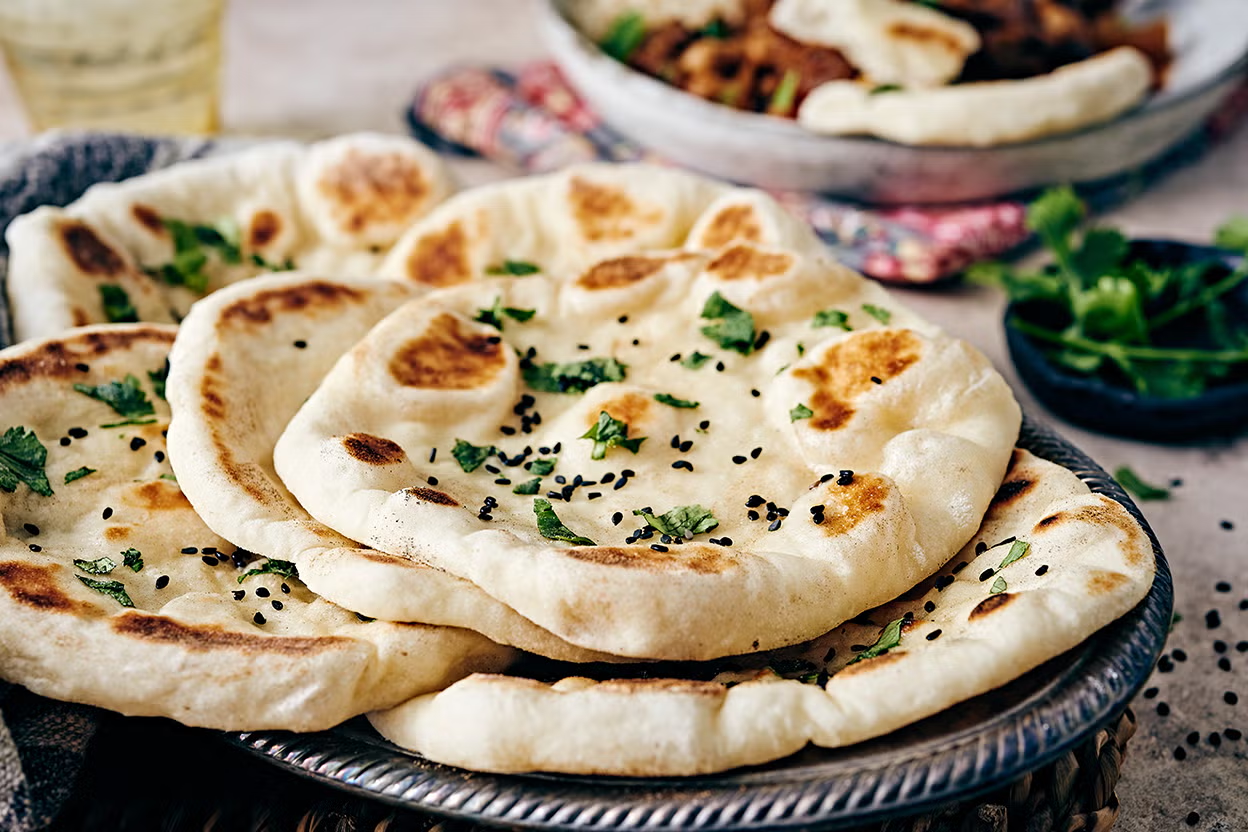
NAAN: The definition of a type of bread that comes in a large, round, flat piece and is usually eaten in many South Asian countries is arrived at from its palindromic feature in this down clue that is seen not only coming down but also rising or going up (that also may rise)
There were many clues that I liked in this puzzle such as 11a, 13a, 15a, 17a, 20a, 25a, 1d, 2d, 3d, 4d, 5d, 21d and 24d; 20a being the best of the lot. My prayers to the Almighty for the eternal rest and peace of BD and my thanks to Dada for the entertainment. Looking forward to being here again. Have a nice day.
Congratulations Rahmat on your 11th Masters degree, it just goes to show that effort and determination pays off. You must, rightly, be proud of your accomplishments. Goodness knows how you find the time to do the blogs with so much interesting detail as well as all your studying. I’m in awe.
Thank you so much, Madflower. I am truly grateful for your kind words. I always feel I have a lot to learn and your encouragement means a great deal to me. To answer your question, I would say that I am able to balance my studies, teaching, writing etc, all by the grace of the Almighty, who has blessed me with the gift of time management and good health.
I echo Madflower’s congratulations, Rahmet. Your many achievements are truly amazing, not to mention humbling. Well done, you. I hope you feel rightly proud.
Thank you so much, jan. I sincerely appreciate your kind words and encouragement. I feel grateful rather than proud, as the more I learn, the more I realise how vast knowledge is. I feel my knowledge is not even a drop in the ocean. There is always so much more to learn and your support still means a great deal to me.
Today is Bengali New Year’s Day. I am a Bengali. My parents and their siblings and parents all spoke Bengali. Coming from a family where Bengali has always been spoken, I wish everyone a Very Happy Bengali New Year. On this occasion, I wish to reveal how the Bengali calendar got its year. That will surely make one nonplussed! We never had 1 Bônggabdo or Bengali Year 1 in history although our ancestors were familiar with their twelve Bengali months of a solar year. The Gregorian calendar, though standardised in the late 16th century, is a solar calendar of 365 days a year and followed by most countries around the world. The Hijri calendar or the Islamic calendar is a lunar calendar of 354 days a year and followed by most Islamic countries. However, ‘Bônggabdo’ or Bengali Year is somewhat a mixture of these two. India’s official civil calendar, that is, the Indian national calendar started from the ‘Saka’ Era (1 SE = 78 AD), albeit the traditional Hindu calendars had existed long before the ‘Saka’ Era. Traditional Hindu calendars today are noticed in two forms viz. solar Hindu calendar and lunisolar Hindu calendar. For the lunisolar Hindu calendar followed by North India, the starting month is ‘Chaitra’ and last month is ‘Phalgun’. Same is the case with the Indian national calendar. For the solar Hindu calendar followed by South and East India, including Bengal, the starting month is ‘Baishakh’ (‘Boishakh’ in Bengali) and last month is ‘Chaitra’ (‘Choitro’ in Bengali). Celebrations of ‘Poila Boishakh’ or Bengali New Year started from the reign of Akbar, the-then Mughal emperor who was ruling over a vast part of the Indian subcontinent. The new ‘Fasli San’ or ‘Agricultural Year’ was introduced on the 10th of March 1584, but was dated from Akbar’s ascension to the throne in 1556. In 1584 Anno Domino (AD), it was 992 Hijri Era (HE) and in 1556 AD, it was 963 HE. Fatehullah Shirazi, a renowned scholar and royal astronomer, formulated the Bengali Year, that came to be known as ‘Bônggabdo’, on the basis of both the ‘Hijri’ lunar and Hindu solar calendars. Shirazi took only the ‘Hijri’ lunar calendar year 963 HE as the base year for ‘Bônggabdo’. Thus, ‘Bônggabdo’ started with 1st of ‘Boishakh’ 963 (corresponding with 963 HE and 1556 AD that year). ‘Boishakh’ always falls in the middle of April, 14th or 15th. Hence, ‘Poila Boishakh’ 1431 was on 14th April 2024, ‘Poila Boishakh’ 1432 was on 15th April 2025 and ‘Poila Boishakh’ 1433 is being celebrated today, the 15th April 2026. Last year, on the 15th of April 2025 of the Gregorian solar calendar, while it was the 1st of ‘Boishakh’ 1432 according to the Bengali solar calendar, it was also the 15th of ‘Shawwal’ (the Eid al-Fitr month or the tenth month of the Islamic calendar) 1446 according to the ‘Hijri’ lunar calendar. This year, on the 15th of April 2026, it is the 1st of ‘Boishakh’ 1433 according to the Bengali solar calendar, but 26th of ‘Shawwal’ (the Eid al-Fitr month) 1447 according to the Hijri lunar calendar. Now, despite the adaptation of the lunar-based ‘Hijri’ or Islamic year 963 as its own base year, ‘Bônggabdo’ did not adapt the months of the lunar calendar of 354 days, but retained the practice of the region following the solar calendar of 365 days. Thus, in a way, it could not keep up its pace with the ‘Hijri’ or Islamic lunar calendar year of 354 days that was 11 days less than the solar calendar year and hence completing a year 11 days before or quicker. Hence, for every year, the ‘Hijri’ lunar calendar gained 11 days or, in other words, it gained 354 days or one lunar year in 354 / 11 = 32.1818 years. That is to say, it completed 33 years in every 32.1818 years of solar calendar. Now, from the base year April 1556 AD to the present 15th day of April 2026 AD, there is a difference of 2026 – 1556 = 470 years. So, in 470 years, the ‘Hijri’ calendar gained 470 x 11 = 5170 days or 5170 / 354 = 14.6045 years. But in these 470 years, there were also 114.5 leap years of 366 days (1 extra day) a year [1700, 1800 and 1900 were not leap years and hence not included in calculation]. So the ‘Hijri’ calendar also gained 114.50 days or 114.50 / 354 = 0.3234 year, making a total gain of 14.6045 0.3234 = 14.9279 years. Thus, 963 470 14.9279 = 1447.9279 or 1447 HE that is the current ‘Hijri’ or Islamic lunar calendar year that already started as a new year last on 26th day of June 2025; 0.9279 being the approximate percentage of days of the year covered since that date, which will also come to near perfection if we take the exact duration of a lunar year that is equal to 354 days, 8 hours, 48 minutes and 34 seconds and it is but obvious that 1448 HE will begin this year on 14th/15th June 2026. And, of course, 963 470 = 1433 ‘Bônggabdo’ that is being celebrated in Bangladesh and in the state of West Bengal and Tripura here in our country as ‘Poila Boishakh’ today, the 15th day of April 2026, that is, the 1st day of ‘Boishakh’ 1433 (Bengali Year based on solar calendar; its base year 963 ‘Bônggabdo’ being a lunar year that was of course adapted from 963 HE). Call whatever you wish – breathtakingly mathemagical or simply mathematical.
3*/3* …
liked 5D “Not the winner, though hardly puffing ? (5,3,2,5)